The basis of capitalism is “the individual will do what’s
good for the individual.” When you consider marketing your product or service,
you need to consider it from your customers’ perspectives. What’s in it for
them?
If you talk about how cold your refrigerator is, you’re
talking about a feature. The refrigerator is cold. So what? What does that mean
to your customer? The refrigerator will keep food fresher longer because of its
cold temperature. The feature is “cold;” the benefit is “fresher food.” Too
many businesses list features and think they are benefits.
A feature is not a benefit. A benefit explains how a product
or service will make the consumers’ lives better, and just because it’s a
benefit for you, doesn’t mean it’s a benefit for someone else. The most
compelling benefits are emotional or financial.
A competitive advantage is a special kind of benefit. It is one that is unique to you or it is something that only you talk about. It’s a benefit that gets the buyer’s attention, sells your product, keeps customers coming back, and causes people to talk about your product. The right competitive advantage buries your competition and should become the focus of your overall marketing plan.
A marketing plan requires information, brain power, and
initiative. Brain power is broken down into analysis, ideas, creativity, and
imagination.
You can make a seven-sentence marketing plan. It should include the purpose of the marketing, the target market, the niche, the benefits or competitive advantage, identity, the tools you have in your marketing bag, and your budget. Guerrilla Marketing adds “investigate new markets in the coming year.”
A good marketing plan requires you to know the market, what
customers expect and want, and how to satisfy them. Plans need to be flexible.
They should include how to attract potential customers, how to convert those
potential customers into purchasers, and how to keep them coming back.
Niche marketing is the opposite of mass marketing. With a niche, you have a specific target segment to aim at; mass marketing is like a shotgun blast. Niche marketing takes advantage of the opportunity to really connect with your target market; mass marketing is the Super Bowl commercial that reaches millions of people, who may or may not be interested in your product or services.
To put it terms of technology: If mass marketing were a
phone, it would be a Smartphone. It takes pictures, accesses the Internet,
allows you to order pizza, and, yes, you could even make a phone call with it.
However, it has so many features that you probably use fewer than half of them.
All of those unused features are things that you paid for and don’t need. Mass
marketing may reach thousands of people, but if only a couple of them are your
target market, it’s a lot of wasted effort, time, and money.
Niche marketing, on the other hand, would be your
old-fashioned, Ma Bell rent-a-phone. It did one thing: Allowed you to make
calls. Those phones lasted forever!
For niche marketing to work, you need to become the expert
in your field. A niche will help you know where to market and to whom, and it
will give you an identity that your competitors don’t have.
When you create a positioning statement, you aren’t creating
a product or service. You are creating a basis for everything you do. You are
positioning your company in the minds of your potential customers. Positioning is
your business’ true identity and its true value.
A positioning statement should say who you are, what
business you’re really in, who buys your products or services, what they demand
and what unique value you bring to them. Our second draft:
At Penguinate.com, we inspire happiness and creativity in professional adults by helping them embrace their inner child through our handmade stuffed animals and plush toys and their costumes.
Positioning statement, our second draft.
The positioning statement should address a real benefit the target audience wants that separates the business from its competition in a unique or difficult to copy way. Positioning should be benefit focused. Joy. Friendship. Travel. Penguins!
“Guerrilla Marketing in 30 Days” advises to find your niche. Your business needs to know who it wants to sell to in every key demographic, including gender, age, income level, when they do their shopping, where they do their shopping, do they have pets, and more. You don’t have to stalk your customers; you may ask them some questions. If you don’t have any customers, you want to just imagine who your ideal customer is. EVERYONE is not a niche, and EVERYONE is not your customer.
Once you have your niche, you want to aim your marketing at
it. In archery, this is known as aiming small, which is a direct contrast to
the phrase “aim big.” Because the bull’s eye is the smallest part of the
target, the closer you can get to it the better. If you “aim big,” you might
get the arrow in the general direction of the target, but you’re not likely to
hit the bull’s eye. If you aim small, you’ll more likely get the hit you want.
In marketing for small businesses, you want to aim your marketing at specific people who are going to purchase your product or service. If you’re objective is to sell sweat-proof makeup to mimes in Las Vegas, as long as there are enough mimes in Vegas, you have a niche. If there aren’t enough mimes, you might want to extend it to stage performers or expand your mime reach to all of Nevada. Your niche needs to be large enough to provide you with an income, but small enough that the larger companies aren’t serving them. Take out your bow, string it, pull back your marketing arrow, and aim small.
Every business needs to have a competitive advantage. This
is something that the business does that others do not, or it is something that
the business talks about that others do not. It needs to be a positive benefit,
communicated with a few well-selected words, and something that people will
relate only to you.
So, what is our competitive advantage? Our penguins are unique
from the norm; have you seen another white penguin on the market? They’re rare
in the wild, too. Our penguins are also unique from each other. No two penguins
look exactly the same because their eyes are hand-embroidered. Their height
fluctuates within a half-inch because they are hand-sewn. How much stuffing gets
used for different penguins is variable as well. Our penguins are also rare.
They are handmade. We only have one maker, so supply is limited. For
collectors, the rarity and uniqueness are benefits.
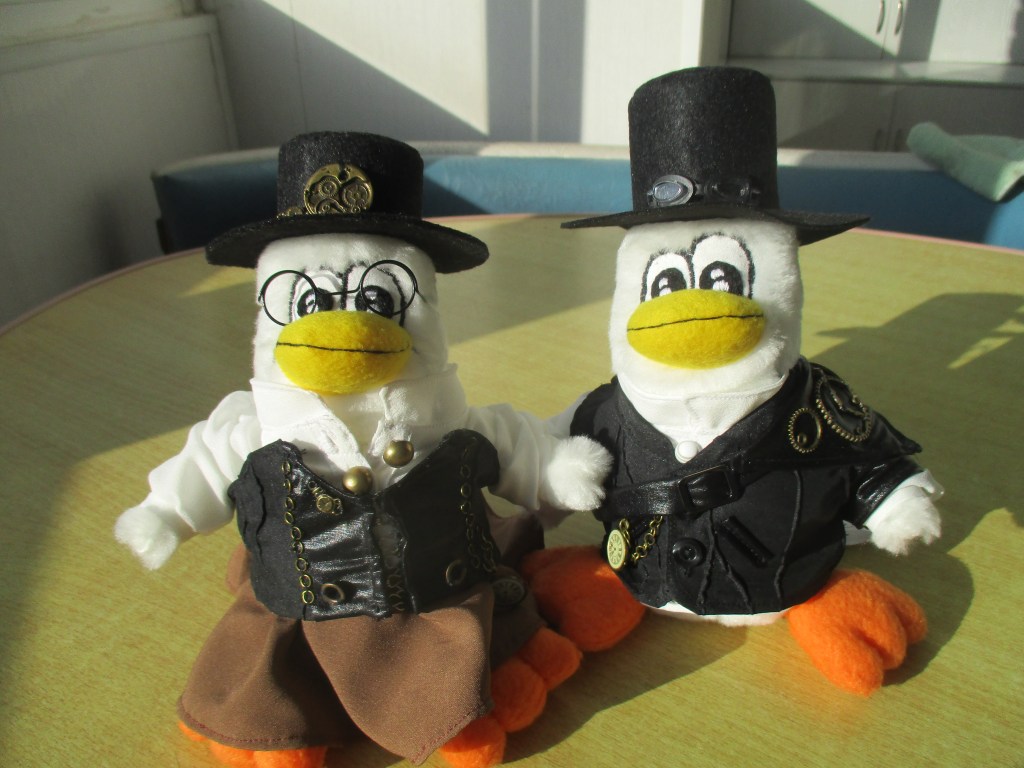
Nathaniel and Eudora Atwater, Steampunk Penguins
A second competitive advantage is that we can make penguins
in costumes that can’t be found anywhere else. If someone wants a particular
style of penguin or costume, Jenya can make it. We’ve done steampunk penguins
as a special order.
A third advantage is our Penguin Passports. Our penguins are
travelers. You can take them with you and use them for Instagram photos and fun
while you travel. The passports reveal their names and their likes. These names
are never the same.
This information is adapted from the 2005 version of “Guerrilla Marketing in 30 Days.” Get an updated version of “Guerrilla Marketing in 30 Days.”
Who is our competition? What problems are they solving? What
benefits are they offering?
I feel like these questions are really putting us in the
position of Scrooge as he struggled against the Ghost of Christmas while trying
to bonnet it. If it could be called a struggle when one side puts all his
effort and might into overcoming the other, who is utterly unaffected by such
exertions. Put me in the 100-yard dash with Usain Bolt, and I still don’t think
he would call me competition.
Steiff Teddy Bears and Other Animals
So, is our competition Steiff?
Founded in 1880, Steiff is the world’s premier manufacturer of high-end toys and collectibles. Indeed, Steiff is the only “luxury” toy brand in the marketplace today. Internationally renowned for its exceptional quality, Steiff still utilizes traditional materials and proven manufacturing techniques to create its unique and highly prized products.
Are they the only luxury toy brand in the marketplace as they claim? They use traditional materials and exceptional quality. What are the problems they are solving and benefits they are offering? They are soft, attractively priced, and from the original teddy bear company. Steiff is basically selling entrance into their exclusivity club and the ability of stuffed animals to return adults to the happier days of childhood. (A $1,295 Winnie the Pooh is labeled as for adults only.) They reach the children with animals around $20. Steiff sells nostalgia, collectability, and investment. Your children deserve the best; Steiff proclaims itself the best and has a history and collector base to back that claim. Steiff’s powerful commercial shows a teddy bear protecting a child from the dark.
Gotta Get a Gund
Founded in 1898, Gund had commercials in the 1980s. They were selling love and playfulness. Nowadays, they’re selling comfort, play, magic, heritage, quality, surprise, imagination, and love. Gund’s website sells bravery and love. Their products are huggable, and the company has been around for more than 100 years (like Steiff). Gund has stuffed animals under $10 and focuses more on their animals’ child friendliness vs. Steiff’s collectability, though both talk about how long their toys will last and are selling their heirloom status.
Ty, Inc. and Beanie Babies
Ty is the #1 plush manufacturer in the world (according to their job listings). Their Beanie Babies were so popular that Teenie Beanie Babies were featured in McDonald’s Happy Meals. People collected them throughout the 1990s, with some having thousands in their collection. Ty has capitalized on the lower income markets and built market share through their products appeal to people who don’t have a lot of money to spend on Steiff or even Gund. With a $2 Happy Meal, you get a Beanie Baby! That’s a pretty price point for anyone who’s hungry or has children; it’s also a way to get loyal customers for life. They are offering play and love as part of their Beanie Baby package! They push the collectibles a bit further by offering surprise toys in a series. The toys are hidden in a box, so you don’t know which one you’re going to get.
Stuffed Animals
The common theme for these companies is love. After all, how
can you not love a stuffed animal. They make great friends, they are fun to
play with, and they provide security to younger people. Being huggable is an important
part of being a plushie.
Our Penguins
Our penguins are soft, cuddly, and fun. Their wings move, and they’re handmade, so every one of them is unique. Their expressions change based on how your emotions and how you perceive what they are doing. Even just standing on a shelf, our penguins speak volumes and tell a story that your heart needs to hear. You adopt our penguins; you don’t buy them.
So, our we competitors to these larger companies? We offer
something none of them can compete with. Our stuffed animals are handmade with
love. My wife makes them. There’s no large factory involved in our basic
penguins. If you order one with clothes, those are handmade as well. Only some
of the accessories, like buttons, may be purchased. Each animal is different
because the eyes are hand-embroidered. Each set of eyes is designed and sewn
differently. And the eyes are the window to the soul.
The object of marketing is to get people to do something. It
can be to donate to a cause. It can be to click on a link. It can be to buy a
product or subscribe to a newsletter. Whatever it is that you want people to do
is what your marketing should be directed it. If you don’t know the goal, you
won’t be able to get people to do anything, and you won’t be able to measure
what works and what doesn’t.
The goals need to be specific, so that they are easier to visualize and achieve. I want people to be more creative, be better problem solvers, experience more joy in life, learn something new, and be happier. Those aren’t goals that I can measure. They may also not be specific enough.
Buy a Penguin
So, how can I help people to achieve those things? If you buy a stuffed penguin, will you be happier? I hope so. I know how happy they’ve made me. So, the first goal is to sell stuffed penguins.
Buy a Book
If you buy one of my books, will you be happier? I hope so. “The Pirate Union” is a comedy. “The Adventures on the Amur” are like the Nancy Drew/Hardy Boys stories. The creativity books are designed to help you become more creative and be better problem solvers. “Polly Penguin Wants to Fly” and “There Are No Penguins in Alaska” are supposed to be fun. So, the second goal is to sell books.
Patreon, Blog, and Email List
Will supporting our Patreon, reading my blog, or joining our email list help you achieve those goals of creativity, joy and problem solving? On Patreon, you get short stories and penguins that should be comforting and funny. The blog will bring about new information that you may not already know, and our email list will make sure you don’t miss anything on the blog. It’s all an attempt to bring you more joy and creativity.
Other Goals
We’ve recently changed our slogan to “Joy. Friendship.
Travel. Penguins!” That’s what we want to bring to this world in as many ways
as possible. But again, they aren’t easily measured.
Are the goals I have currently too many? They need to be
realistic, and I need to make sure that I don’t get overwhelmed with too many
of them or with goals that are too large. Goals that are too easy or too hard
aren’t realistic. You need to stretch yourself, without breaking, to achieve
success. You need to believe that you can achieve the goals.
Books, coffee, penguins, Disney, travel and creativity are
things that bring me happiness. I want the freedom to explore, create and
build, so I can bring that happiness to you.
So, what are good goals to set? That’ll depend on the month and
the activities we’ve got going on.
Adapted from the 2005 version of “Guerrilla Marketing in 30 Days.” Get the updated version of “Guerrilla Marketing in 30 Days.”
“You can’t sell a product or service no one knows about (Levinson and Lautenslager, p. 2).” This is what I am confronted with every day in every conversation. We have great penguins and books, but how do we get people to find out about them? Marketing starts with your mindset. It requires energy, enthusiasm and passion. Every action, especially for an individually owned business, is a part of marketing. How people see you will transfer to how they view your business. In their book “Guerrilla Marketing in 30 Days,” the question that Levinson and Lautenslager say every member of the organization should ask themselves is “How am I building awareness with my prospects and clients through our marketing?”
I typically ask myself, “How do I best move forward?”
Sometimes, it’s by creating something new – a book or an article. Sometimes, it’s
by posting or reposting something to social media, and sometimes, I can’t
answer that question at all because I am wondering how do I best stay afloat.
It’s a balancing act – we have to cover our current moment and figure out how
to move forward for the future. I don’t recall the two ever coming together.
Our marketing needs to be tied to our mission statement: Joy.
Friendship. Travel. Penguins! That’s the closest we’ve got to a mission statement.
It’s more of a slogan, I guess.
The first step in marketing, like creativity and any other activity, is believing that you can. Your actions will make a difference. Once you have this locked in, you can keep doing the activities you need to do in order to market. Those activities like laundry, dishes, and breathing, never stop.
One way to learn more about marketing is to simply observe
what is already around us. Look at the emails that are spam: Which do you open
and why? Which do you delete without opening? What works? Why do you open one
and not the other? Adapt the successful ones to your business.
Always think about the customer. It’s not what you offer or
what the features are; it’s what the benefit is for the person getting the
product. Our penguins are soft, but that’s a feature. The benefit of a soft
penguin is that you have someone who feels good to hold. Our penguins can comfort
you and relieve stress (benefits) because there are no hard parts that can hurt
you (features). Always discuss benefits. How do our penguins or books help improve
your life?
This information has been adapted from “Guerrilla Marketing in 30 Days” from 2005. You can get an updated version through this affiliate link for “Guerrilla Marketing in 30 Days” from 2014.
 Penguinate! Positive Creativity