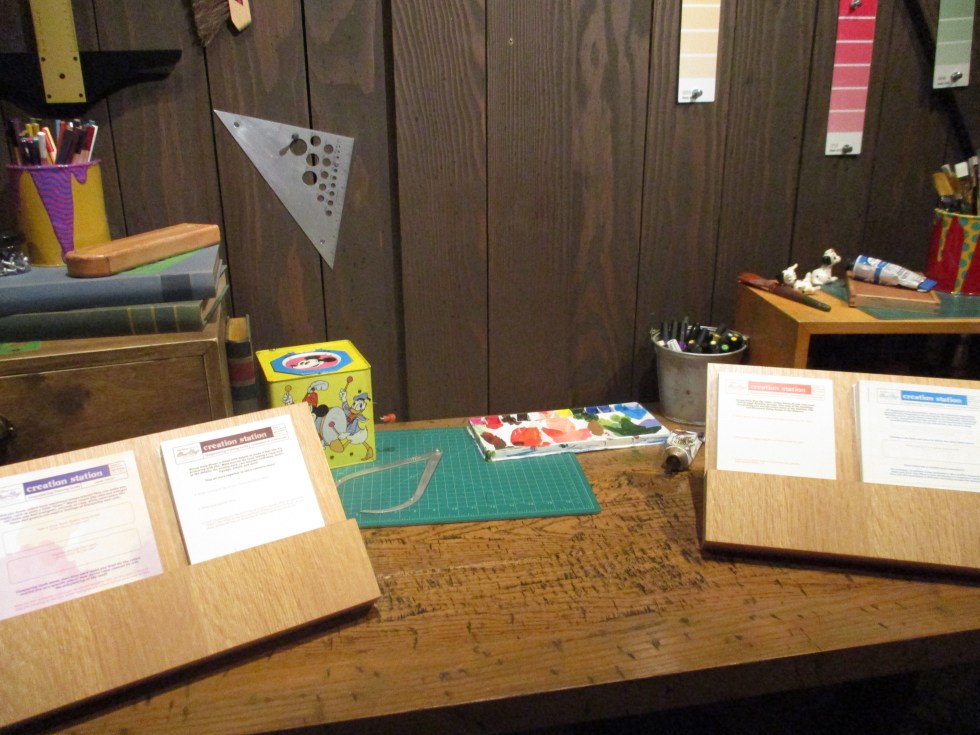
Do You Know How Many Articles I Can Write on Creativity in a Month?

Have you ever wanted to know how many articles I could write on creativity in a month? Generally, I spread my writing out with travel articles, movie and book reviews, penguins and Disney-related material. Oftentimes, there’s an overlap between these subjects and creativity; sometimes, I don’t point the overlap out. What does this have to do with anything?

For the last week of July at our Patreon page, I am issuing a challenge to you, the members of my Patreon and myself. For every five new members that pledge at any level, I will write an article about creativity for all of the Penguinators. If 20 people join, I will write 4 articles for the challenge and one because that’s what I normally write. If 50 people join, I will write 10 articles plus one or more depending on the other goals we achieve. If 150 people join, I will write 30 articles plus one or more depending on the other goals we achieve. That would be at least one a day for the month of August!

I’m pretty confident I can write one a day because I’ve been able to do that at my website for the last 210 days. In fact, I think I can write as many as five articles a day, but that would mean 750 people would have to sign up at our Patreon page.

If you want to know how many articles on creativity I can write over the course of a month, you’ll need to join our Patreon and encourage your friends, family members and colleagues to join. Will you accept the challenge to find out what I am capable of? Let’s find out.
Curiosity Leads Down the ‘Penguin Highway’

In “Penguin Highway” by Tomihiko Morimi, Aoyama is a curious boy in the fourth grade. He takes copious notes, researches everything, makes observations, and never gets angry. When ever he feels like he might get angry, he thinks of breasts, and it calms him down. Is that normal for a fourth grader? I don’t know, but it’s normal for Aoyama, who is clearly not an ordinary child.

When Aoyama is confronted with several problems, he decides to research them all. His friend Uchida and the girl Hamamoto help him with the time he has to spend on researching “The Sea.” Uchida is also part of his exploring and mapping the town. His side project is researching the lady from the dentist office who can make penguins, which is what sparks the whole story.

Aoyama shows that its not good enough to ask the questions. He keeps a journal with him at all times. Hamamoto does the same, and Uchida learns to use a notebook, even if he isn’t the smartest one in the group. Taking notes allows Aoyama to access the information he has learned at a later time. It also allows him to manipulate the data, so he can get a bigger picture.

Taking notes requires observation skills. Aoyama has practiced observing, so he sees what others may miss. He then makes hypotheses and tests them to see if they can withstand the scientific method. He knows his theories are most likely wrong, but it’s important to make and test them.

Aoyama’s methods are honed and only missing one piece – sometimes, the answer doesn’t lie in the logic of a situation or possible behavior. In creativity, the process is similar: take notes, observe, ask questions and stay curious; sometimes, you have to make that intuitive leap to a better answer.

If you’re looking for another good read, check out these books on my website.

‘The Lion King’ Be Prepared for Disappointment

When Pamela Travers confronted Walt Disney about changes she wanted to see in “Mary Poppins” after the film premiered, Walt Disney said, “Pamela, that ship has sailed.” It was one of Walt’s frustration with film. Once it was done, he could change it or tinker with it to make it better. It’s part of the reason he created Disneyland; it gave him something he could change and improve. You would think that the company’s live action – or in ‘the Lion King’s” case, CGI animated – films would allow them to improve on the story.

You’d be wrong. Jon Favreau’s self-proclaimed live action “Lion King” does nothing to improve up on the original and eliminates some of the best parts of the 1994 classic. Was there nothing the filmmakers thought they could improve upon?

The elimination of Ed the hyena who communicated through laughter is one large change. It was Ed’s change from bumbling fool to evil, backstabber that was the most frightening change in the original.

The “Be Prepared” sequence lacks the emotional impact that the Jeremy Irons number had. The visuals and message in the original are staggeringly relevant and scary. It may have been the best song in the movie.

Favreau’s animals are limited to the things that animals can do. This necessitated a huge change to the visuals for the “I Just Can’t Wait to Be King” number. There’s no Hula dancing meerkat, and staff-wielding Rafiki is only revealed in a lackluster moment of no import. Rafiki pulls the staff out of a hiding place in the tree and says, “My old friend.” There’s no connection to this staff in the film, so this statement doesn’t serve a purpose, except as fulfilling fan expectations. Seriously, you don’t need any fan appreciation because it’s ALL fan appreciation.

I can respect that Favreau wanted to make these animals photo-realistic; it’s something Disney tried to do with Bambi in 1940. But in doing so, Favreau eliminated a lot of what makes the 1994 version a standout film. In fact, this new version doesn’t even do justice to the stage play, which was truly something new and fresh when it debuted – and it’s still a work of art.

The last battle between Scar and Simba has less drama than an episode of “Mutual of Omaha’s Wild Kingdom” where the lions’ strength would be on full display. Here, it comes off as “Man, this would be powerful if they were real lions in the wild; instead, it’s artificially enhanced by sound effects.”

In the past Disney released their animated films in the theater every seven years so new children could become acquainted with them. That worked for the new “Aladdin.” There were enough changes that it was clear the movie was released for the next generation. “The Lion King” just seems like it was developed because the original made a billion dollars. For those who love the originals, the 2019 version plays like “Phantom Menace” without a new plot line.

Things to Like about Independence, OR: The Independence Cinema

Few small towns can claim a valuable gem like the Independence Cinema. With eight screens, people who live in Independence or Monmouth, OR, have a variety of films available to see (not just one or two).

However, the biggest advantage of the Independence Cinema for those nearby is the price. With tickets at major chains running upwards of $10 for matinees, the local cinema is offering Super Tuesdays: all films, all ages, just $5. On Tuesday, every theater should be filled with people who love movies. People from Salem and Dallas should be making their way to Independence for a cheap date night. Take it one step further and be sure to get a rewards card. Then every movie you see and every combo you purchase gets you one step closer to free admission to a movie not exempted by the star policy.

 You can get a great deal on concessions, too. Popcorn and soda are still unreasonably high for any place but a movie theater. However, the pizza and the chicken basket are killer deals costing about the same price as a fast food restaurant. At Independence Cinema, dinner and a movie don’t cost an arm and a leg!

Congress Denies 9/11 Responders Their Due

I was on my couch eating cereal. I had a late workday scheduled because I was going to have to teach another CPR class. That meant I didn’t have to be at work until 10 or 10:30 am. I put my bowl in the sink and went down to my car. That’s when I heard the news: A plane crashed into the World Trade Center.

“Stupid ass morning radio shows. That’s not even funny” was my first thought and I changed the channel to hear the same thing. A plane had crashed into the World Trade Center. “That’s weird. Why would two radio stations be making the same bad joke.” I changed stations again. A plane had crashed into the World Trade Center.

“Holy shit.” It was real. I stepped on the gas pedal and picked up speed as I headed to my job at the American Red Cross. I made it to the office, and it was dead silent. I went to the lounge and my colleagues were glued to the TV. I made it just in time to see the second plane plunge into the World Trade Center. It was unreal, or surreal, or just crazy and the towers came down.

The phones began ringing and would slow down for about a week. Disaster training classes were packed, and we responded to the emergency from all over the United States. We were outraged, angry, concerned, mortified… America had lost its innocence and its insulation. The fabric of our society could’ve unraveled with a tug in the wrong direction, but that wasn’t the full story.

While our government was working at dividing the country along religious and racial lines due to the perpetrators of this heinous act, first responders – the people on the ground – were working to find survivors, to clean the wreckage and to bring America hope. Volunteers lined up, filling rooms for training and deployment, spilling out the doors and into the parking lot. Donations poured in to help the victims.

Yes, we faced despair and our mortality, but we faced it together. We were stronger because of those who were able to be on site helping. The first responders did more than take care of the World Trade Center and its surroundings; they took care of us as a country. Unifying us in a way that our leaders refused to do.

It’s time to look toward those first responders who were injured or have fallen ill because of exposure to toxins released when the Twin Towers came down. They can unite us again, and they should. They took care of us; it’s time we take care of them. Shame on the Senate, and specifically Rand Paul, for putting money before people. 9/11 – we’ll never forget. Let’s make sure they know what they mean and meant to this nation before it’s too late. Phone your senator, the president, and your rep and tell them to take care of our 9/11 First Responders in the way they should be taken care of.

I was on my couch eating cereal. Where were you when the World Trade Center went down? Where are you now that the first responders need our help?

The ABCs of Creativity: Uplifting

Your creativity is a powerful tool that you can harness for better or worse. You can use it to unleash your fears and doubts or to capture them and put them on canvas or paper. You can use it to bring yourself greater joy and to reach for self-actualization. You can use your creativity to harm people or you can use it to uplift them. Conspiracy theorists are as creative at telling stories as novelists are. Bank robbers solve the problems associate with their chosen profession with creativity. Creativity is only a tool and you choose what to do with it.

It’s hard to always choose to use creativity to be uplifting. It can be difficult in the face of abject poverty and bald-faced lies to summon the courage to bring creative solutions to the problem to bear. Oftentimes, we get dragged down by the news and reality of a society that values profits over people. As creatives, we need to turn our efforts to making a better world for everyone.

Of course, that better world starts with us. By reaching out our hands and offering to lift people up, we will make our own situations better and more bearable. Give your creativity over to what it was meant to do – help you make life better for you as an individual and for human race. Be uplifting, create uplifting works of art, and create something that makes you, and those around you, happy.

For more on creativity, get “Disneyland Is Creativity.” Order “The Haunted Mansion Is Creativity.” Purchase “Penguinate! Essays and Short Stories” for positive creativity.

Kindness takes a trip on “The Kindness Diaries” Season 2, Episode 1

In “The Kindness Diaries,” Leon Logothetis is traveling from Alaska to Argentina relying on the kindness of strangers to feed him and give him lodging. He’s driving a Volkswagen Beetle without a heater in the winter over the Al-Can through Canada.

We were just into the first part of the show, before he made it to Canada, when my wife asked me if people in Alaska were really that kind. I got teary-eyed remembering my time there because yes, they are.

Alaska is a harsh and lonely country. I once traveled on a highway for three hours, and no other car passed me. If you get in trouble, you need the very next person who passes by to stop and assist you. Alaskans, in general, are more than happy to do so because they know what they would want if they were in trouble.

Most of the kindnesses I received while in Alaska were from friends. My first camping trip with a couple of people I barely knew set the stage for the next six years. I received freshly caught salmon on more than one occasion. Even a couple of my rooming situations sprang up because I had a friend who needed a renter, and he was willing to rent to me (at a price I could afford even when I was a student).

I don’t know if I paid back all the kindnesses. I gave my fair share of unexpected gifts. I stopped at traffic accidents in town (because of my Red Cross training and that same friend who rented me a room on more than one occasion).

One time we stopped to see what the vehicle at the top of a hill just outside of Valdez was doing – maybe he was parked, maybe he was taking a break. The truck was broken. My friend and I didn’t know how to fix his vehicle, so we drove back toward Valdez to a phone that the guy could use. (Cell phones were out of range at the time.) When he made the call, we drove him back to the truck though we would have driven him into Valdez if he needed. He gave us fresh caught prawns. I would have refused, but again, my friend was there to accept the gift, and we turned it into one of the best meals I had in Alaska.

Alaskans aren’t friendly because of guns or out of fear. They’re friendly because they know the value of life. They know the value of kindness. They know how hard it is to survive on the frontier. As much as many of them move to get away from people, I always felt like I could count on them to help me out before I experienced any real trouble.

We need more kindness in our lives. Alaska taught me that, and this program has brought back memories.

One of My Weaknesses: Building a Virtual Community

I’m not any good at building a virtual community. I’m not sure why. My Twitter account hovers around 230 followers, usually fewer. My YouTube page is at about 250 subscribers. My Patreon has five dedicated and amazing Penguinators (Thank you!). The only reason I have over 1,000 Facebook friends is because I played a game called Castle Age for four years and I needed friends to get prizes (DfA!).

However, a virtual community is what I need to build to survive as a writer. I need a group of individuals who will interact with my webpage and social media. People who will share penguin posts and buy books and penguins. A core group of active fans, who can help get the word out and keep my TV series on the air for another season (figuratively speaking), would be amazing.

Taylor Swift has her Swifties. Haley Reinhart has her Haliens. Firefly has its Browncoats. Justin Bieber has his Beliebers. What’s the name of J.K. Rowling’s fans? These fans are there to support and protect their chosen artists, and just such a fan base is what every creator needs.

I’ve seen examples of fan-building, but I don’t know how to use my personality to do it. All I know is that I need to figure it out and quickly. Change is coming, and when it does, I’m going to need a lot of support and a lot of change.

How would you build a virtual community?

Heroes of the Haunted Mansion: Rolly Crump

At about the 7-minute mark: Rolly and his Museum of the Weird.

Walt Disney assigned Rolly Crump to work with Yale Gracey on the Haunted Mansion in 1959. Rolly maintains that he learned a lot from Yale during their time together. They were given a room on the second floor of the animation building, and they had a year to develop illusions specifically for the Haunted Mansion.

Rolly came to Walt’s attention when Ward Kimball told Walt about Rolly’s propeller sculptures. IN 1964, Rolly would apply his knowledge of kinetic sculptures to the “Tower of the Four Winds” for the 1964-65 World’s Fair.

Rolly’s Haunted Mansion concepts were considered too weird by his fellow imagineers. Walt, however, thought they could be used in a spillover area where guests could interact with a chair that talked, the melting candleman, or a coffin-styled grandfather clock. Rolly also came up with a concept for a haunted gypsy cart. Walt called it the “Museum of the Weird.” The concept failed to materialize after Walt’s death.

Rolly and Yale were giving time and freedom to do what they wanted with their day. The created the illusions that are part of one of the most beloved attractions at Disneyland. Even though the Museum of the Weird never materialized, Rolly’s willingness to try new things made him a great imagineer. You can follow his example and try new things, too!

Sources: “The Haunted Mansion: Imagineering a Disney Classic” by Jason Surrell.

Walt Disney’s Imagineering Legends and the Genesis of the Disney Theme Park” by Jeff Kurtti.

For more on creativity and the Haunted Mansion, get “The Haunted Mansion Is Creativity” online or at the Candy Cane Inn in Anaheim.

For more on Disneyland and Creativity, order “Disneyland Is Creativity.” For deep thinking about the Disney Company, check out “Penguinate! The Disney Company.”

You can also find more articles about Disney, Disneyland and creativity at our archive website, www.penguinate.weebly.com, and on our blog. If you would like to get even more articles about creativity, join our Patreon and become a Penguinator.