Heroes of the Haunted Mansion: Marc Davis

Marc Davis is one of Walt’s Nine Old Men, who worked many of the early films designing characters that included animals from Bambi and Maleficent. When Marc Davis came over to WED, he brought his sense of humor with him. He added humorous scenes to the Jungle Cruise and was one of the main designers of the Pirates of the Caribbean.

When he was brought on to the Haunted Mansion project, he had to struggle with Claude Coats and his design preferences. The two men were equals in the office. Coats wanted a scary Mansion; Davis wanted something funnier. A compromise of sorts was reached, and Coats’ influence can be seen at the beginning of the attraction with Davis’ scenes becoming stronger in the end.

“I think that’s the whole thing with creativity is if there’s something new out there, why not give it a try?” said Marc Davis (Disney Family Album). Use Marc Davis as your motivation and give something new a try.

Sources: “The Haunted Mansion: Imagineering a Disney Classic” by Jason Surrell.

“Disney Family Album #17 – Marc Davis” at https://youtu.be/pVf6DdqkpjU

For more on creativity and the Haunted Mansion, get “The Haunted Mansion Is Creativity” online or at the Candy Cane Inn in Anaheim.

For more on Disneyland and Creativity, order “Disneyland Is Creativity.” For deep thinking about the Disney Company, check out “Penguinate! The Disney Company.”

You can also find more articles about Disney, Disneyland and creativity at our archive website, www.penguinate.weebly.com, and on our blog. If you would like to get even more articles about creativity, join our Patreon and become a Penguinator.
Heroes of the Haunted Mansion: Rolly Crump

At about the 7-minute mark: Rolly and his Museum of the Weird.

Walt Disney assigned Rolly Crump to work with Yale Gracey on the Haunted Mansion in 1959. Rolly maintains that he learned a lot from Yale during their time together. They were given a room on the second floor of the animation building, and they had a year to develop illusions specifically for the Haunted Mansion.

Rolly came to Walt’s attention when Ward Kimball told Walt about Rolly’s propeller sculptures. IN 1964, Rolly would apply his knowledge of kinetic sculptures to the “Tower of the Four Winds” for the 1964-65 World’s Fair.

Rolly’s Haunted Mansion concepts were considered too weird by his fellow imagineers. Walt, however, thought they could be used in a spillover area where guests could interact with a chair that talked, the melting candleman, or a coffin-styled grandfather clock. Rolly also came up with a concept for a haunted gypsy cart. Walt called it the “Museum of the Weird.” The concept failed to materialize after Walt’s death.

Rolly and Yale were giving time and freedom to do what they wanted with their day. The created the illusions that are part of one of the most beloved attractions at Disneyland. Even though the Museum of the Weird never materialized, Rolly’s willingness to try new things made him a great imagineer. You can follow his example and try new things, too!

Sources: “The Haunted Mansion: Imagineering a Disney Classic” by Jason Surrell.

Walt Disney’s Imagineering Legends and the Genesis of the Disney Theme Park” by Jeff Kurtti.

For more on creativity and the Haunted Mansion, get “The Haunted Mansion Is Creativity” online or at the Candy Cane Inn in Anaheim.

For more on Disneyland and Creativity, order “Disneyland Is Creativity.” For deep thinking about the Disney Company, check out “Penguinate! The Disney Company.”

You can also find more articles about Disney, Disneyland and creativity at our archive website, www.penguinate.weebly.com, and on our blog. If you would like to get even more articles about creativity, join our Patreon and become a Penguinator.

Heroes of the Haunted Mansion: Yale Gracey

Yale Gracey joined the Disney Company in 1939 as a layout artist. He worked on “Pinocchio,” “Fantasia” and “the Three Caballeros.” In 1959, Walt Disney set Gracey up with Rolly Crump and gave them a large room on the second floor of the animation building. They were instructed to come up with effects for the Haunted Mansion.

As the son of an American Consul, Gracey grew up in various places and had to learn to entertain himself. He filled his days with “Popular Mechanics’ and the book set called “Boy Mechanic.” He also practiced magic.

Gracey had no formal training in special effects, but his curiosity often led to him building miniatures to see if he could get an effect to work. According to Bob Gurr (Kurtti, p. 72), Gracey was given the time and space to tinker without deadlines, and Walt was fine with whatever new thing Gracey invented.

Gracey projected the face of the Magic Mirror on everything in the room one day. It led to the development of the Madame Leota effect (Kurtti, p. 73). Gracey also put the Pepper’s Ghost effect to use in the Haunted Mansion to create the Ballroom scene. Gracey died under mysterious circumstances in 1983.

Gracey tried to do new things. He tinkered, and he followed his curiosity. You can do the same thing. Follow your curiosity and create something new.

Sources: “The Haunted Mansion: Imagineering a Disney Classic” by Jason Surrell.

Walt Disney’s Imagineering Legends and the Genesis of the Disney Theme Park” by Jeff Kurtti.

For more on creativity and the Haunted Mansion, get “The Haunted Mansion Is Creativity” online or at the Candy Cane Inn in Anaheim.

For more on Disneyland and Creativity, order “Disneyland Is Creativity.” For deep thinking about the Disney Company, check out “Penguinate! The Disney Company.”

You can also find more articles about Disney, Disneyland and creativity at our archive website, www.penguinate.weebly.com, and on our blog. If you would like to get even more articles about creativity, join our Patreon and become a Penguinator.

Check out my Interview at the Sweep Spot!

I was interviewed by Ken Pellman and Lynn Barron from The Sweep Spot for “The Haunted Mansion Is Creativity!” My newest book uses the history and structure of the Haunted Mansion, just in time for its 50th anniversary, to illustrate creativity principles.

Ken and Lynn are former cast members from Disneyland. The Sweep Spot is a podcast that talks about all things Disney, including current events. The two hosts have written “Cleaning the Kingdom” and will be releasing their second book “Cleaning the Kingdom: Night, Day Past and Present” on July 17. Visit their website and check out their books, t-shirts and Patreon.

During Podcast 263, I am at about the 30-minute mark for stories about the Haunted Mansion, Journey Into Imagination and creativity. After my interview is Alastair Dallas, author of “Inventing Disneyland.” Check out the podcast and get some books!

Heroes of the Haunted Mansion: Ken Anderson

Ken Anderson was laid off by MGM in 1934. He was married and spent a month “living on the beaches and eating canned beans and what-not” (The Disney Family Album). He applied to the Walt Disney Company at the urging of his wife Polly even though his education was in architecture. Anderson’s additional accomplishments include work on “The Goddess of Spring,” “Ferdinand the Bull,” and “Snow White and the Seven Dwarfs.”

Anderson was the first imagineer to really work on the Haunted Mansion as an attraction. Harper Goff did a drawing of a haunted house as part of the Mickey Mouse park Walt Disney was considering in 1951, and Marvin Davis gave a haunted mansion a place in Disneyland that never materialized.

In 1957, Anderson wrote his first storylines for the Haunted Mansion. He researched houses in the south and went to the Winchester Mystery House to look at group movements and timings. His storylines included a captain/pirate who killed his new bride, a ghostly family that kept the mansion from being renovated, a tour led by Walt Disney, and a mansion that used the Headless Horseman and the classic monsters of literature.

Anderson suffered a stroke after the release of “101 Dalmatians.” He lost the ability to move and was left blind by the stroke. He had “absolutely no control” over his body. He came back with the inspiration from a grove of trees and worked on Shere Khan for “The Jungle Book.”

Ken Anderson worked for Disney for 44 years. He is one of the few unsung heroes of the Haunted Mansion. Without his first treatments and ideas for the inside, we may not have the classic attraction that exists today. Let his example help you improve your work situation, perseverance and creativity.

Sources: “The Haunted Mansion: Imagineering a Disney Classic” by Jason Surrell.

“The Disney Family Album: Ken Anderson” aired on the Disney Channel in 1984. Accessed at https://youtu.be/mSPnwK2yPtQ

“Ken Anderson; Disney Art Director, 84” in the New York Times. Accessed at https://www.nytimes.com/1993/12/19/obituaries/ken-anderson-disney-art-director-84.html

For more on creativity and the Haunted Mansion, get “The Haunted Mansion Is Creativity” online or at the Candy Cane Inn in Anaheim.

For more on Disneyland and Creativity, order “Disneyland Is Creativity.” For deep thinking about the Disney Company, check out “Penguinate! The Disney Company.”

You can also find more articles about Disney, Disneyland and creativity at our archive website, www.penguinate.weebly.com, and on our blog. If you would like to get even more articles about creativity, join our Patreon and become a Penguinator.

‘The Haunted Mansion Is Creativity’ eBook Now Available at Amazon.com for Preorder

In case you missed it, “The Haunted Mansion Is Creativity” is available for preorder at Amazon.com. The second book in the “Disneyland Is Creativity” takes a look at the Haunted Mansion’s history and structure and relates them to creativity principles to help you become more creative.

While the Haunted Mansion opened on August 9, 1969, it’s history dates back more than a decade before when Harper Goff drew the first haunted house concept in 1951 as part of a church and graveyard. The façade was finished in 1963, but it took 6 more years for the technology to develop and the concept to work. This delay allowed the Disney team to learn more as well as explore hundreds of ideas before choosing the right one. Creativity requires lots of ideas, time to be creative, and patience to choose the right idea to develop.

That doesn’t mean there weren’t failures. The Haunted Mansion was supposed to open in 1963 instead, Marty Sklar wrote a sign that said the team was busy gathering ghosts. A short-lived effect called “the Hatbox Ghost” didn’t work when the Haunted Mansion opened, and it was removed until the effect could be done correctly. (It was reinstalled in 2015.) Creativity comes with failures and mistakes.

Just in time to celebrate Disneyland’s Haunted Mansion’s 50th anniversary, the eBook is scheduled to be released June 1 and 2 to coincide with Lilac City Comicon 2019 in Spokane where I will be presenting “The Haunted Mansion: 50 Years of Creativity.”

The book tour will continue at City Cakes and Café in Salt Lake City. On June 7 to 9, we’ll be at Ogden UnCon where I will present “The Haunted Mansion: 50 Years of Creativity” on Sunday. Currently, our last scheduled stop will be at Amazing Las Vegas Comic Con from June 14 to 16.

Click on the link to preorder “The Haunted Mansion Is Creativity” in paperback. Get “Disneyland Is Creativity” in paperback here and in eBook on Amazon.

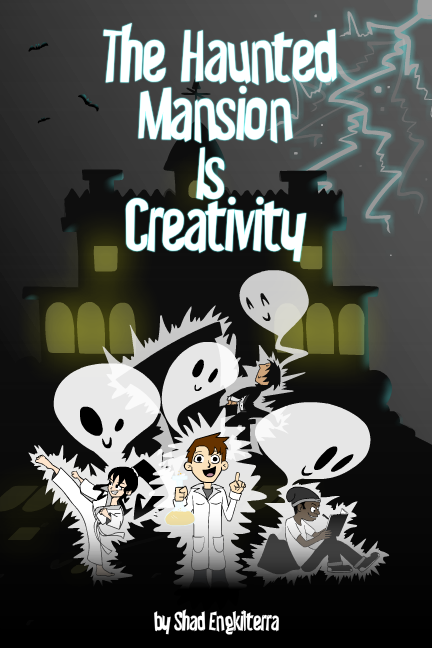
The Cover Reveal for ‘The Haunted Mansion Is Creativity’

The Haunted Mansion was always my favorite Disneyland attraction growing up. Sure, I enjoyed singing and clapping with the Country Bears. I had fun sailing with pirates in the Caribbean, and I really loved Adventures thru Inner Space. However, it was the Haunted Mansion and its magic that remained the attraction I would choose to go on first.

This year marks the Haunted Mansion’s 50th anniversary. Because of that, I wanted to delve deeper into its history and its links to creative principles. From the late 1950s when Ken Anderson was the only imagineer assigned to the project through to Yale Gracey and Rolly Crump’s shenanigans to opening day and beyond, “The Haunted Mansion Is Creativity” takes you on a tour of the home of 999 happy haunts linking attraction details and designs as well as stories of its creation to creative principles as revealed through scientific studies and interviews with people who create for a living.

The Haunted Mansion Is Creativity” is scheduled to be available on June 1, 2019. I will be presenting “The Haunted Mansion: 50 Years of Creativity” at Lilac City Comicon 2019 and Ogden UnCon 2019.

Without further ado… Here is the amazing cover for “The Haunted Mansion Is Creativity” designed by Antonisa Scott and Transcend Studio:

The Secrets of Creativity: Play (and the Haunted Mansion)

When Walt Disney assigned Yale Gracey and Rolly Crump to the Haunted Mansion, he gave them time and space to play. Gracey and Crump were assigned to come up with ideas and effects for the Disneyland attraction. They would come into the studio and work on whatever they felt like. As Marty Sklar put it in the forward to Jason Surrell’s “The Haunted Mansion: Imagineering a Disney Classic,” “Yale and Rolly Crump, especially, were free to experiment, to try out their wildest haunting ideas… to ‘play ghost’ if you will.”

Continue reading

My Niece, the Haunted Mansion and Fear

When my oldest niece was about five, my mom and I took her on the Haunted Mansion. We went through the Stretching Room, down the Portrait Gallery and boarded the same Doom Buggy. As we rolled up the stairs and into the mansion, I was getting into it. The Haunted Mansion isn’t scary, but it’s fun to pretend it is.

So, I was taking everything seriously. The armor, the endless hallway with the floating candelabra, the chair that seems to be staring at you. Each new “horror” made me look more fearful. As we rotated to see the body trying to get out of the coffin, my mom hit me in the shoulder.

“Lighten up. You’re scaring your niece,” she whispered at me.

I switched the way I was looking at the mansion and laughed at its humorous elements. I kept smiling through the ride, and my niece had a great time. She wasn’t afraid of no ghosts.

Fortunately, the team of Claude Coats and Marc Davis helped to provide the elements of a frightening atmosphere and comic presentations. (Of course, there are plenty of contributions from other prominent imagineers, like Rolly Crump and his human-like furniture and wallpaper and the effects pioneered by Yale Gracey with Crump.) So, you can see the Haunted Mansion the way you want to. It is the creativity that the team put into the mansion that makes it a classic attraction that everyone loves.

For more on the Haunted Mansion and creativity, preorder “The Haunted Mansion Is Creativity.” You can also get “Disneyland Is Creativity” and “Penguinate! Essays and Short Stories: Improve your Creativity for a Better Life and World.”

For more on the Disney Company, preorder “Penguinate! The Disney Company.”

Disneyland’s Haunted Mansion Exterior and trouble accepting new ideas

In a story about Ignaz Semmelweis, the survival rate of children and their mothers, and handwashing included in his book “How to Fly a Horse,” Kevin Ashton points out that even in a “field as empirical and scientific as medicine… Creation is seldom welcome” (74 – 76). People need creativity and change, and they resist it at the same time. It’s part of the dichotomy of being human.

When Walt Disney wanted his imagineers to envision and create a haunted house for his theme park, they all came up with the same idea: a decrepit, run-down building that had ghosts. Walt didn’t like it. He didn’t want a run-down building ruining his pristine park.

According to Sam Gennawey’s “The Disneyland Story,” Ken Anderson, the original lead on the Haunted Mansion as we now know it, wanted to hide the run-down mansion behind trees native to Louisiana. Walt didn’t go for it.

Harriet Burns built three models for Walt to choose from. The imagineers put the pristine building behind the other two decrepit versions. Walt chose the beautiful building every time. He wanted guests to feel welcome in his park; that meant everything had to be clean and in good repair, even the haunted mansion.

Walt was working with some of the most creative people in the planet. Imagineers knew Walt, had experienced his success and demeanor first hand. Even when he told them, “We’ll take care of the outside and let the ghosts take care of the inside” (Surrell, Jason, “The Haunted Mansion: Imagineering a Disney Classic,” p. 13), they insisted on trying to convince him that a haunted house needed to look a certain way.

“Everyone expects a residence for ghosts to be run-down. But Walt was always looking for the unexpected,” (Genneway, p. 180) said Claude Coats.

When those who consider themselves creative and create for a living have trouble accepting new ideas and ways of doing things, everyone else has even greater problems to accept the changes that come with innovations. It’s okay. We just need to realize that creativity is just as necessary for the advancement of humanity as being wary of the change that it brings is. As soon as we can embrace our seemingly opposed sides, we can see they are working together to make us more successful, as long as we don’t let one win over the other all the time.

For more on creativity, get “Disneyland Is Creativity: 25 Tips for Becoming More Creative.” Order “Penguinate! Essays and Short Stories.” Preorder “The Haunted Mansion Is Creativity.” For more on the Disney Company, preorder “Penguinate! The Disney Company” officially releasing on April 14, 2019.