Creativity comes when people aren’t afraid to make connections
or sound dumb. People don’t like to be judged or have their ideas called
stupid, even if they sound out there. Brainstorming sessions attempt to put
people in a safe place where there is no judgement and they can dream as big as
they want to. As an idea generation practice, Brainstorming can provide
hundreds to thousands of ideas, depending on how many people participate and
how long the session is.
Brainstorming sessions should have between 8 and 12 people. The session should last about 45 minutes to an hour though longer sessions can be advantageous if there are appropriate breaks. All brainstorming sessions have rules. At Disney in their blue-sky sessions, imagineers follow these rules according to “The Imagineering Field Guide to Disneyland”:
There is no such thing as a bad idea.
No talking about why it can’t be done.
Do not stifle ideas with “buts,” “can’ts” and other negative words.
There’s no such thing as a bad idea.
Not everyone agrees that brainstorming is a good idea. Edward de Bono says it’s a waste because so many ideas are discarded and the time to come up with them is wasted thereby. The process is inefficient. However, creativity is inefficient, so the brainstorming session, when the plan begins, should be the most inefficient part of the process.
De Bono also notices that some people try to top others, so the session results in people coming up with the most outlandish ideas. For me, that’s part of the point of brainstorming. Like Disney imagineers, I believe you never know where the best idea is going to come from, and it could come from a connection to an outrageous idea that someone else had.
Others decry the fact that brainstorming sessions have no
follow up step. That’s up to the business to create. Recording the ideas and
having the team follow up is easier if someone has the authority, time and
resources to move forward with new ideas.
If you want to have a lot of ideas to choose from, start
with a brainstorming session.
After 13 episodes of “Salvation” the most unforgivable action came from an assassin. He shoots his target at close range in the shoulder, then shoots a bystander in the chest and head. He had surprise on his side, so this should have been an easy task. Instead of checking on his target to see if she was still alive or dead, he douses everything in flammable liquids and starts a fire.
Dude. Seriously? You’re an assassin. Your next move after shooting the bystander would’ve been to go around the desk and finish off the target. Morgan Freeman in “Nurse Betty” said it best, “Three in the head, you know their dead.” (I use the quote in “The Pirate Union.”)
Because this professional killer and cleaner didn’t do his
job, the target was able to send an incriminating email and accomplish the
task, her death was supposed to prevent. We aren’t 100 percent sure that she’s
dead, so it might be that this assassin did not complete his mission at all.
Maybe, this makes the story more interesting, but come on.
All I want is for people to do their jobs well. Whatever your profession,
whatever work you do, do it well. Even if you don’t like it. Until you quit,
you need to instill in yourself the habits that will transfer to any other work
you choose. Doing the job correctly should be a top priority for everyone who
is employed.
And, I guess, I also want a story that’s a little more
believable. The fate of the world is in question; this assassin knew that the
target needed to be eliminated. He should’ve completed the job correctly.
Most people want an easy answer, and the simpler the
explanation the better. Unfortunately, these answers and explanations leave much
to be desired, and they stymie creativity. Creativity is the process that
humans go through when they create something new. It involves not knowing where
one is going as much as it involves having a goal. While the two may seem to be
diametrically opposed, they are actually both appropriate for creativity.
Ambiguity is the idea that you don’t know the answer. If you
knew the answer, you wouldn’t need creativity to solve the problem unless you
were looking for a better answer. Trying to find a path to the goal, you look
for solutions, you don’t know which one will work or what you’ll find, but you
stay the course and keep moving forward. With each experiment you get closer to
your goal, but you don’t know when you’ll get there.
Nike faced this issue of ambiguity in 1971 when, as head of Blue Ribbon Sports, Phil Knight realized the relationship he had with the Japanese shoe manufacturer that would become Asics was headed south according to Popular Mechanics. He needed an innovation to stay in the shoe game.
Nike co-founder Bill Bowerman was facing a problem with his
athletes in Eugene. A new urethane tack had been installed at the university
and the athletes were having problems gaining traction on it. Metal spikes
couldn’t be used because they destroyed the track. Bowerman looked at
everything and anything that could help provide traction. He needed something
that would work on multiple surfaces. He needed to be able to make a pattern on
the soles of the shoes.
His wife decided to help him on a Sunday morning and made
waffles. Bowerman looked at the waffle maker and thought it could work to make
his soles. He ruined that waffle maker but was undeterred and went out to get
more waffle makers. He had his sole, and Nike had its game changing innovation
for athletic shoes.
Bowerman, and Nike, had to go through a period of ambiguity
while he was searching for the answer to his problem. There was no guarantee
that he would solve the problem and there was no template that showed him how
to solve it. He had to keep looking in spite of earlier failures. He had to
deal with ambiguity.
When you’re confronted with a problem that you don’t know
how to solve, or even where to begin to solve it, you could walk away. Or you could
look at it as a challenge and enter the ambiguous path that leads to creativity
and innovation.
Sometime in early January, I started looking for a charity that supported penguins. It seemed like something we should do at penguinate.com. Penguins are cute, funny, the basis for our mascot and our lead creativity identity marker. I just didn’t find a lot out there on penguin charities and their effectiveness (much of what I found was for the Pittsburgh Penguins Hockey Team charity efforts).
Then I saw a trailer for DisneyNature’s “Penguins.” Ignoring the fact that the penguin’s name is Steve (hmmm… Steve), the movie looks like it has a lot of compelling penguin footage. Also mentioned in that trailer is DisneyNature’s commitment to give a portion of the opening week’s box office to the Global Penguin Society (GPS), which has a partnership with the World Conservation Network (WCN). In this case, as a Disney fan, I’ll let the DisneyNature film guide me to contribute to the GPS.
Jenya and I discussed it and we decided we would give to the
GPS through the WCN $1 for every penguin we sell. That way we can do our part
to make sure penguins are around long enough for us to go see them in the wild.
Wildlife Conservation Network has a 100 score and 4-star rating from Charity Navigator. Global Penguin Society won the 2018 Whitley Gold Award and the 2018 and the National Geographic Buffet Award for Leadership in Conservation presented to Dr. Garcia Borboroglu. Ten of the 18 species of penguins are vulnerable or endangered according to the IUCN.
Get a cute stuffed penguin today and help us support efforts to improve their numbers.
One of the reasons why video games are so popular and so
easy to play for hours is because they set up quantifiable goals that allow you
to understand whether you’re being successful or failing. It’s not just save the
princess; it’s save the princess while scoring the most points or doing so in
the fastest time. Hardcore gamers will sit for hours trying to gain levels, get
treasure, discover secrets, complete side quests, and feel accomplished. Even
gamers who play Match 3 games or Farmville have goals they can measure – one more
level to complete or a certain score to attain. The numbers are tracked, saved,
compared to your friends, and celebrated when milestones are reached.
Every so often, I get caught up in one of those point-and-click
Facebook games, like Farmville or Castle Age, and I become totally obsessed
with them. I’m building characters. I’m building farms. I’m building castles. I’m
fighting monsters. I’m raking in the fake currency. I’m completing quests, and
in the best of these, I’m connecting with people on the Internet I will
probably never meet in person. In short, these games allow me the opportunity
to feel successful and enjoy the feeling of actually building toward something.
It’s a feeling that seriously lacks in real life.
No matter how many blog posts I write, how many books I
sell, or how many SEO articles I write, I don’t see the results that show I am
building toward something. Instead, my real life looks like I am spinning my
wheels and staying afloat, with the weather and waves threatening to change all
that.
These games have a time element and a rewards system. Just
wait five minutes, and you get another point, or energy bolt, or gold piece to
spend. Of course, you always have the option of throwing the developers some
real money to get more of whatever makes the game go. The more you play, the
more new lands you find the more powers you develop and the more secrets you
discover.
Discovery also lacks in life, even as I seek out new
experiences and new information. It seems like I am surrounded by old
information that is told in different ways over and over. It’s like looking up
30 articles on heart attacks to see that chest pain is the most common symptom
for men. It’s something we all know. Isn’t there anything new out there?
Recently, I got caught up in “Magic the Gathering: Arena.”
It’s a great game. You collect cards and decks. You build decks, and then you
battle against other people that you can’t really communicate with. It has all
the elements I love: Discovery, strategy and card collecting. (I had so many Magic
cards when I was in my teens and twenties.) And then there’s the winning – who doesn’t
love winning? I just can’t continue on with it knowing the responsibilities I
have.
These games are time- and attention-stealers. They don’t do anything to advance you forward, and if you’re like me, they suck you in and reduce your effectiveness in other areas of your life. If you’re thinking about the next reward you can get in your match three gems game or Candy Crush, you’re not thinking about how to solve other problems you’re facing or how to help other people get through life better. Yes, they are fun, and if you can play them in moderation, more power to you. I, however, cannot. Now, if there were a point-and-click game that translated into helping people. That might be a game worth getting lost in.
You are unique. They want to experience your uniqueness.
They love you!
They want to travel with you.
They love your room.
They need a hug.
They like the same movies that you do.
They’ll be a perfect photo models for your photos!
They like fishing.
They think you are cute!
They want to share stories and coffee with you.
You’re creative. They love that about you!
Penguins in the wild are endangered. Our stuffed penguins want to help their friends. For every penguin adopted, we’ll give $1 to the Global Penguin Society.
“Trust is the most valuable commodity in the world” –
paraphrased from the Russian Defense Minister Toporov on “Salvation.”
In fewer than six months, the world will end. All it would
take to save the world is to launch a gravity tractor equipped with the newly
developed EM drive into space. It seems like it should be a relatively simple
thing to accomplish. The biggest issue is that no one trusts each other enough
to let anyone else do his or her thing, and it starts at the top with the
governments of Russia and the U.S.
REM: It’s the End of the World as We Know It (And I Feel Fine)
Russia cuts off all diplomatic ties to the U.S. and threatens war. They know the asteroid is coming, and they don’t have the ability to build an EM drive, in spite of having kidnapped one of the scientists responsible for its invention. Russia threatens to shoot down anything shot into space and has already destroyed any satellite capable of crashing into the asteroid (which they should do, because if the asteroid is blown to pieces, it will result in a lot of meteors raining down on Russia and other countries in the Eastern Hemisphere rather than an extinction level event.) Russia threatens these things because they found that the U.S. has already dropped one asteroid on them (using the real-life Chelyabinsk meteor as part of its story).
Kaa the Python: Trust in Me
The U.S. president refuses to acknowledge the action, and
the only way to move forward with a launch is for billionaire Darius Tanz to
take PR official Grace Barrows to Moscow. Barrows is friends with the former ambassador,
who may be able to arrange a meeting with the Minister of Defense. Pointless
shenanigans (meaning the death of Barrows’ friend and the frame-up of Tanz and
Barrows for her murder by polonium) ensue and the two meet with Toporov, who
demands a test of their trust. Barrows and Tanz drink the tea laced with
SP-117, which is not sodium pentothal, and tell the truth about what they want
and how they propose to get it.
Russia still doesn’t trust the U.S., but it trusts Tanz and
Barrows. The launch is a go. Yay! We’re going to save the world with a joint
operation between the U.S. and Russia… Scrap that. The world learns about the
asteroid, and Russia withdraws its people again. The Secretary of Defense sends
up the rocket with the only EM drive, as far as he knows, and it gets shot
down. The world will be destroyed because government officials couldn’t do the
right thing. The only plan anyone has left is to shoot nuclear missiles at the
asteroid as it gets closer, and every scientist has already said that plan won’t
work. (Tanz has a secret plan, but the Secretary of Defense doesn’t know this
at the time he makes his stupid decision.)
Liam, the kid scientist responsible for the discovery of the
asteroid and calling its attention to Tanz and then develops the EM drive,
finally gets his ex-girlfriend Jillian back to Tanz Industries to do a job she’s
uniquely qualified for. She may be willing to get back together with Liam;
after all, she had to keep the secret from her family and discovered how difficult
it was. Then, the reporter shows up, attempts to blackmail Liam and reveals to Jillian
that they kissed. Liam is dumbstruck.
First of all, this is not how a good reporter behaves. However,
it’s the second time that this particular reporter attempted to blackmail
someone. She has also made friends with people who could provide her with
information for her story. She’s going to get the story regardless of the
morality involved in the methods to get it. Her story is the reason the
Russians pull out of the launch deal. She is also the reason why Liam and
Jillian have more trust issues than before.
Billy Joel: A Matter of Trust
While in Russia, Barrows and Tanz engage in a tete-a-tete,
which results in an SP-117 kiss. Barrows is dating Harris Edwards, her boss at
the Department of Defense. This action would likely undermine their relationship
by destroying the trust they have in one another, but back in the states, it’s
clear that Edwards doesn’t trust her. Professionally, he revokes her security clearance;
personally, he goes to a bar and has sex in the bathroom with the bartender.
When Barrows gets back to the U.S., he arrests her and then accuses her of
sleeping with Tanz. Dude, that ship sailed when you went to the bathroom with
the bartender. What gives him that right? Oh, and he’s being set up by someone
to make it look like he ordered Barrows to be assassinated.
Fleetwood Mac: Little Lies
Barrows daughter doesn’t trust her and ends up in Re/Syst. Tanz makes a deal with RE/SYST, who tack on a malware program to monitor Tanz’ work from here on out. With all of the lies and deception, it’s hard to see how anyone will gain another person’s trust.
Instead of people trusting in each other, we’re stuck with a
bunch of egos, lies, and the inability to let it go for the sake of saving the
human race. Everyone is involved in making shady deals and shadier decisions
that work to undermine what little trust they’ve built up. Worse, everyone is
ready to believe the worst of someone else; they turn on a dime regardless of
their confessed feelings. If this show is any indication of the truth about
people and trust, there is little difficulty in believing that a few people at
the top will wind up destroying the Earth for petty reasons and because they
lack the humanity, intelligence, and moral compass required to do the right
thing for everyone rather than the right thing for themselves. If people facing
the end of the world can’t trust each other, how can normal people in everyday
life expect to do so?
Trust isn’t an easy thing to rebuild. Once it’s broken,
there are few people who are big enough to build it back up, and few people who
change for the better in order to justify rebuilding the relationship. Human beings
are creatures of habit. If a person engages in behavior that destroys trust he
or she will probably engage in the same behavior again no matter the good
intentions the person may have. The point is: Trust is the most important
commodity in the world. The world is ending for someone every day; inspire
trust and help make it easier to face.
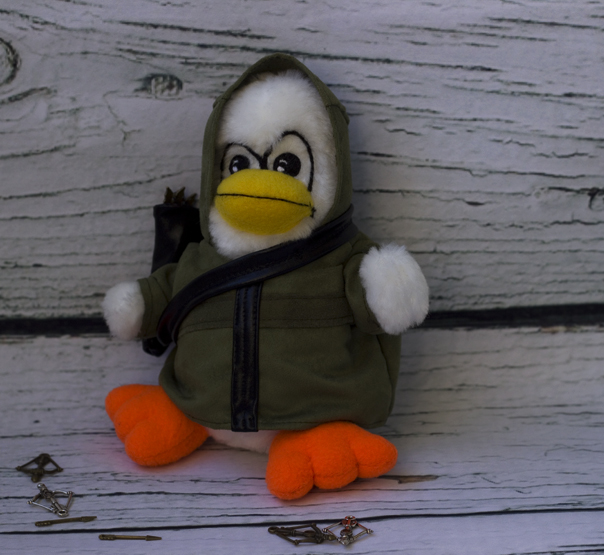
Stuffed penguin Patch is looking to bring happiness and joy to a lucky home. This penguin’s cute face and soft body are perfect for cuddling. Patch loves to find adventures and is the best listener, especially when you’re telling about the adventures you’ve had or want to have. If you need someone to support your creative endeavors, Patch is the penguin for the job.
Our newest penguin is the second in the Black and White
series. Patch is made with faux snow leopard fur, which features super soft
white fur with black undertones. Patch’s feet and beak are made from fabric for
toy plushies. His eyes are hand embroidered, and he’s stuffed with Holofiber.
Patch stands at about 6.5 inches. If you’d like to dress Patch in a handmade outfit
of your choosing, we can do that.
Our stuffed penguins are handmade with joy and love. They make us laugh when we see them, and each has its own personality. If you’d like to order Patch, click on the link below. Or choose another penguin, we have our original colors and several already have costumes.
Steve Jobs said that creative people aren’t smarter than
other people; they just have more dots to connect. Jobs believed that
creativity came when someone connected two seemingly unrelated things to create
something new that had value. But what is a dot exactly?
A dot is a fact or piece of knowledge that someone has. People
who are trained in baking have a lot of dots about cooking times, what ingredients
work well together, what ingredients do when they are heated up, how long dough
should rise, and everything else about baking. If that’s their specialty, they
will be knowledgeable about baking because they have learned about it. They may
have memorized the recipe for a perfect wedding cake, but if it’s no their own
recipe, they can’t be said to be creative, yet (even though baking does create
something).
It’s not just the dot that has value for creativity. If someone
has two dots and that person doesn’t connect them, no creativity has taken
place. It’s the line between the two dots that is important. This is, what I call,
the “thinking deeply” part of creativity. It takes a thought process to connect
the parts together into something that makes something new. Sometimes, this
thought process is conscious; sometimes, it’s in the subconscious and shows up
as an “AHA!” moment. Either way, the person has a problem that he or she has been
presented with, and the solution comes because of the thinking not only about
the problem but also about everything he or she has learned before.
One of my favorite connect-the-dots moments comes from the story of Velcro. Invented by Swiss engineer George de Mestral, who loved hiking in the woods, Velcro came after a hike when de Mestral found burrs on his clothes. He was curious if the burrs could have a commercial application. He studied the burrs under a microscope, did eight years of research and product development and created the hook and loops to make Velcro work.
This story has the dots – hiking and engineering, the curiosity to ask the question, and the thinking deeply – studying a burr and working to create something like it. Velcro was patented in 1955, the same year that Disneyland was opened. De Mestral was ridiculed, suffered his fair share of failures, but thanks to his stick-to-it-iveness, the company sold 60 million yards of Velcro during his lifetime. When you learn something new and think deeply about how it can be applied to a problem, you’re opening up your imagination and opening the door to creativity.


 Penguinate! Positive Creativity